Flat Roof Replacement in Denver: TPO vs. EPDM vs. Modified Bitumen Compared
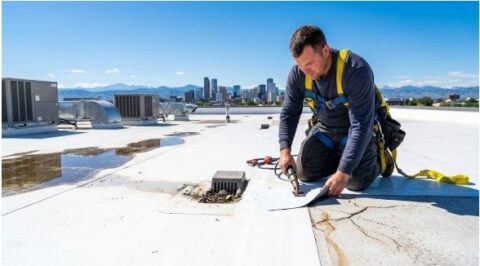
Drive through RiNo, LoHi, or any of Denver’s modern commercial corridors you’ll often notice the flat roofs. However, when a flat roof starts leaking, it rarely stays small: water begins to pond instead of draining, moisture seeps under the membrane, and a minor ceiling stain can quickly turn into structural damage.
If you own a flat roof in Denver, replacement isn’t if—it’s when. The real question is: Which roofing system gives you the best performance for your building and budget?
The three most common options are:
- TPO (Thermoplastic Polyolefin)
- EPDM (Rubber Roofing)
- Modified Bitumen
Here’s a real comparison.
TPO vs EPDM vs Modified Bitumen (Quick Comparison Table)
| Feature | TPO | EPDM | Modified Bitumen |
| Lifespan | 20–30 yrs | 25–30 yrs | 20–25 yrs |
| UV Resistance | Excellent | Good | Good |
| Seam Strength | Heat-welded (strongest) | Adhesive (weaker) | Layered |
| Puncture Resistance | Medium | Medium | High |
| Maintenance | Low | Moderate | Low |
| Best Use | Commercial | Budget projects | High-traffic roofs |
What “Flat Roof” Actually Means
Before getting into the materials, a quick clarification: a “flat” roof isn’t truly flat. It has a slight slope, usually a quarter inch per foot, to direct water toward drains and scuppers. That slope matters because flat roofs live or die based on how well they handle water. A pitched roof can shrug off a downpour. A flat roof has to channel and seal it.
That’s why material choice matters more on a flat roof than on a sloped one. The membrane is doing all the work.
TPO: The Modern Default
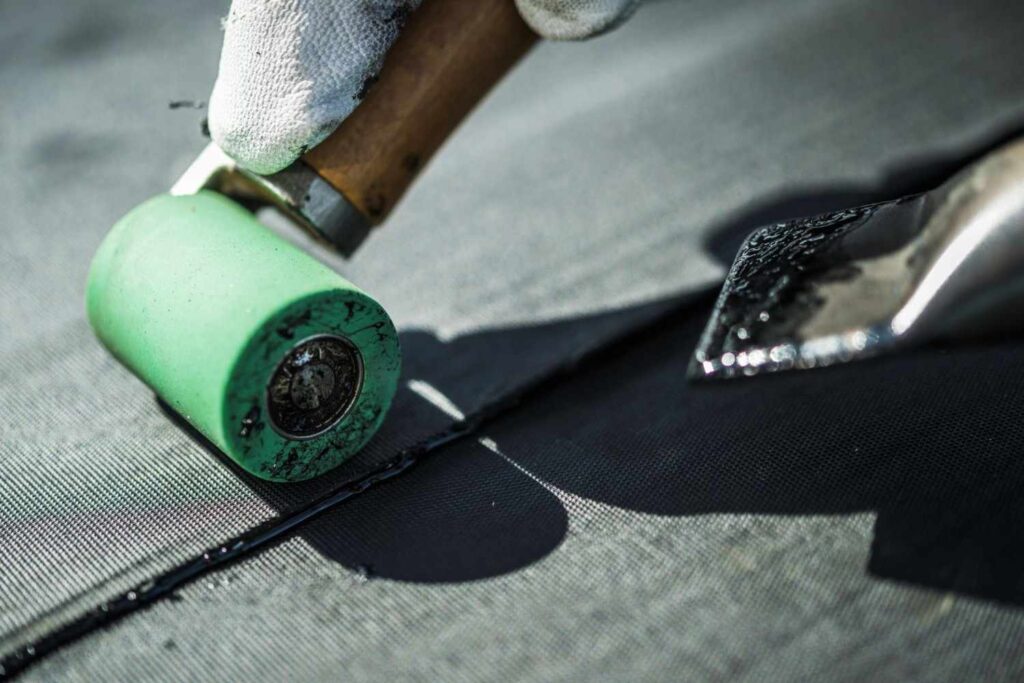
TPO (thermoplastic polyolefin) is what you’re seeing on most of Denver’s newer commercial buildings, those bright white roofs you can spot from any rooftop bar in the city. It’s a single-ply membrane that’s heat-welded at the seams to create a watertight surface.
Why people choose it
- Energy efficiency is the biggest selling point. The white reflective surface bounces heat away from the building, which means lower cooling costs in Denver’s high-altitude summer sun. We routinely see commercial property owners shave 10% to 15% off summer cooling bills after switching from a darker membrane.
- Strong performance against UV exposure, which matters at Denver’s altitude where UV intensity runs about 25% higher than at sea level.
- Heat-welded seams that, when installed properly, are stronger than the membrane itself.
- Lower installed cost than most other premium options.
What to know
- Quality varies dramatically between manufacturers. The thickness matters. We recommend 60-mil or 80-mil for Colorado, never 45-mil.
- Installation is everything with TPO. A bad weld is a guaranteed leak in two or three years. Make sure your contractor is manufacturer-certified.
Best for: Commercial buildings, modern residential builds, properties where energy efficiency is a priority, and anyone wanting the longest expected lifespan from a single-ply system.
Lifespan: 20 to 30 years with proper installation.
EPDM: The Proven Workhorse
EPDM (ethylene propylene diene monomer), what most contractors just call “rubber roofing,” has been around since the 1960s and has the longest real-world track record of any flat roof material. It’s a synthetic rubber membrane that comes in large sheets, typically black, that get adhered to the roof with seam tape or fully bonded with adhesive.
Why do people choose it
- Proven longevity. There are EPDM roofs in Colorado still going strong after 35 years.
- Flexible enough to handle Denver’s brutal freeze-thaw cycles without cracking.
- Tough resistance to hail compared to other single-ply membranes.
- Generally, lower upfront cost than TPO.
What to know
- Standard EPDM is black, which absorbs heat. That’s a benefit in winter (helps melt snow) but adds to summer cooling loads. White EPDM is available but costs more.
- Seams are taped or glued, not welded. That makes seam quality a long-term maintenance item. Most leaks on EPDM roofs eventually show up at the seams.
Best for: Property owners who prioritize proven durability over energy efficiency, smaller commercial buildings, and any project where budget is tighter but you don’t want to compromise on lifespan.
Lifespan: 25 to 30 years.
Modified Bitumen: The Heavy-Duty Option
Modified bitumen (often called “mod bit”) is the modernized cousin of the old built-up tar-and-gravel roofs your grandfather might have had. It’s an asphalt-based membrane reinforced with polyester or fiberglass and modified with rubber polymers (SBS) or plastic polymers (APP) for flexibility.
Why do people choose it
- Multi-ply systems mean redundant waterproofing layers. If one layer takes damage, the next layer is still doing its job.
- Tough as nails. This is the system we recommend for roofs that get foot traffic, HVAC equipment access, rooftop seating, anything where people are walking around regularly.
- Excellent resistance to mechanical damage from dropped tools, debris, or hail.
- Surface options include a granulated finish (similar to shingles) for added UV protection.
What to know
- Heavier than single-ply systems. The roof structure has to support it.
- Installation is typically torch-applied or self-adhered. Torch-applied requires careful work, especially around any combustible materials. We generally prefer self-adhered for residential applications.
- Higher upfront cost than EPDM, comparable to or slightly above TPO, depending on the system.
Best for: Buildings with heavy foot traffic, complex rooftop equipment, or applications where puncture resistance is critical. Also a strong choice for residential flat roofs over living spaces where you want maximum redundancy.
Lifespan: 20 to 25 years for most systems; high-end SBS systems can push 30.
Quick Side-by-Side
To make this practical:
Best energy efficiency: TPO (white, reflective)
Best track record: EPDM (60+ years of field data)
Best puncture resistance: Modified bitumen (multi-layer)
Best for tight budgets: EPDM
Best for premium commercial: TPO at 80-mil
Best for residential flat roofs: Modified bitumen or 80-mil TPO
What This Means for Your Denver Property
Honestly? There is no universal “best.” The right call depends on your building’s structure, your budget, what’s already up there, and what you need the roof to do for the next 20 to 30 years. We’ve installed all three across the Denver metro and have seen each one perform well when it’s the right fit, and fail prematurely when it’s the wrong fit or poorly installed.
What never changes is this: installation quality matters more than material choice. A well-installed EPDM roof will outlast a poorly installed TPO roof every time. When you’re getting bids, ask the contractor how long they’ve been installing the specific system, whether they’re manufacturer-certified, and what their workmanship warranty covers.
Talk to a Local Roofer Who Installs All Three
303 Roofer installs TPO, EPDM, and modified bitumen across Denver’s commercial and residential markets. We don’t push one system over another. We look at your specific building, your budget, and what makes sense long-term, then give you a straight recommendation.
Ready to figure out what your flat roof actually needs? Call us at (303) 390-1382 or schedule a free roof inspection. We’ll tell you what you’ve got, what condition it’s in, and what your real options are.
Frequently Asked Questions
Q1. How much does a flat roof replacement cost in Denver?
Ans: For most commercial properties, expect $7 to $14 per square foot installed, depending on the system, size, and complexity. Residential flat roofs typically run a bit higher per square foot due to access and detail work. The only way to get a real number is an on-site inspection.
Q2. Can I install a flat roof over my existing one?
Ans: Sometimes. Building codes generally allow one re-cover over an existing flat roof, but only if the existing membrane is dry and structurally sound. We always recommend a tear-off if the old membrane is wet or damaged. Covering up problems just creates bigger problems down the road.
Q3. How often should a flat roof be inspected?
Ans: Twice a year, ideally. Once in spring after the freeze-thaw cycle and once in fall before winter. Flat roofs collect debris that blocks drains, and small membrane issues are much cheaper to fix early.
Q4. Will a flat roof leak in heavy snow?
Ans: A properly designed and maintained flat roof handles snow well. Problems usually come from blocked drains, ponding water that freezes, or aging membranes. Regular inspection prevents most snow-related issues.
Q5. Which flat roof system has the best warranty?
Ans: Manufacturer warranties on TPO and EPDM commonly run 20 to 30 years for the membrane. Modified bitumen warranties are similar. Workmanship warranties from your contractor are separate and equally important. Ask about both.

Related Blog Articles