Best Roof for Colorado Mountains: Materials, Costs, and What Actually Lasts
The best roof for Colorado mountains homes is typically standing seam metal roofing, prized for its snow-shedding ability, fire resistance, and 40-70+ year lifespan, though Class 4 impact-resistant architectural shingles remain the most practical value choice for many homeowners when paired with proper underlayment and ventilation.
Mountain roofing in Colorado has to survive conditions most roofs never face: extreme snow loads, intense UV exposure, daily freeze-thaw swings, and wildfire risk, all at once. This guide breaks down which materials actually hold up at elevation, what they cost to install, and what to prioritize whether you’re in Breckenridge, Vail, Summit County, or anywhere else in the high country.
Why Colorado Mountain Roofs Face Harder Conditions Than Front Range Roofs
Mountain roofs endure heavier snow loads, stronger UV exposure, and wider temperature swings than roofs at lower elevations, which is why materials that perform fine in Denver often fail early above 8,000 feet.
Snow loads vary dramatically by elevation and county. Ground snow loads can sit under 20 psf in lower foothill areas but climb to 100-140+ psf or higher in many high-elevation zones, including parts of Summit and Eagle counties. A roof’s structural design and material need to be engineered for the specific snow load at that elevation, not a generic statewide average.
UV exposure at high altitude runs roughly 25% higher than sea-level locations at the same latitude, which accelerates the breakdown of asphalt shingles in particular. Combined with frequent 40-50°F daily temperature swings, mountain roofing goes through constant freeze-thaw stress that pushes moisture into flashing, seams, and underlayment – a leading cause of ice dams and early material failure.
Wind, hail, and wildfire add further demands. Mountain wind tends to concentrate stress on ridges and roof edges, hail is a factor (though generally less dominant in the high country than on the Front Range), and wildfire exposure makes Class A fire-rated materials a priority for many mountain properties.
Best Roofing Materials for Colorado Mountain Homes Compared
The right roofing material for a Colorado mountain home depends on snow load, budget, HOA rules, and how long you plan to own the property — there is no single best option that fits every home.
| Material | Typical Lifespan in CO Climate | Key Strengths | Key Drawbacks | Relative Cost |
| Standing seam metal | 40-70+ years | Excellent snow shedding, fire resistance, low maintenance, handles wind and UV well | Higher upfront cost; can dent from hail (usually cosmetic) | Highest |
| Class 4 impact-resistant architectural asphalt | 15-30 years | Best overall value for many homes; performs well with proper ice/water shield and ventilation; easier repairs | Shorter lifespan than metal; more vulnerable without upgrades | Lowest to mid |
| Synthetic/composite (slate or shake look) | 40-50+ years | Fire resistance, lighter than real slate, durable, flexible aesthetics | Higher cost than standard asphalt | Mid to high |
| Natural slate or tile | 75-100+ years (slate), 40-75+ years (tile) | Extreme durability and aesthetics | Very heavy, may require structural reinforcement, brittle in some freeze-thaw conditions | Highest |
Standing Seam Metal Roofing for Colorado Mountains
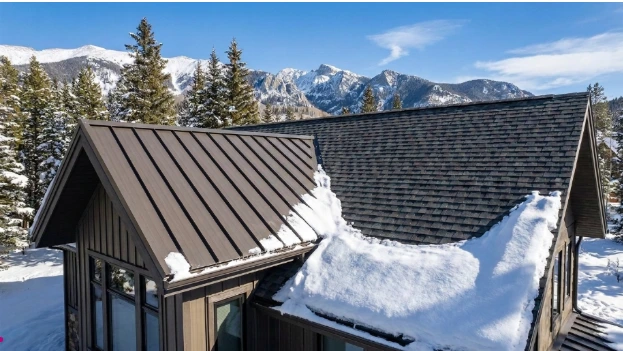
Standing seam metal roofing is frequently considered the best overall choice for Colorado mountain homes because it sheds snow efficiently, resists fire, and lasts 40 to 70 years or more with minimal maintenance. Its interlocking panel design prevents snow buildup that can overload a roof structure, and its non-combustible surface is a major advantage in wildfire-prone areas.
The main tradeoff is upfront cost, along with the fact that large hail can dent metal panels – though this damage is typically cosmetic rather than functional. For homeowners planning to stay in a mountain property long-term, or in areas where HOA rules allow it, standing seam metal is usually the strongest long-term investment.
Class 4 Impact-Resistant Shingles: The Practical Value Choice
Architectural asphalt shingles rated Class 4 for impact resistance are the most common and often the best-value roofing choice for the majority of Colorado mountain homes, especially when installed with upgraded underlayment, ice and water shield, and proper attic ventilation. On their own, standard asphalt shingles tend to have a shorter lifespan in mountain climates than national averages, largely due to UV exposure and hail – but Class 4 shingles close much of that gap.
Class 4 shingles can also qualify for insurance premium discounts of roughly 15% to 35% on the wind and hail portion of a policy, which offsets some of the material’s higher cost compared to standard three-tab shingles. For homeowners balancing budget against durability, this is usually the starting point.
Synthetic Slate and Composite Roofing
Synthetic composite roofing, styled to look like slate or shake, offers 40 to 50+ years of lifespan with significantly less weight than natural slate, making it a strong middle-ground option for mountain homes that want a high-end look without the structural demands of real stone. Fire resistance and durability are comparable to premium materials, at a mid-to-high cost point below true slate.
Natural Slate and Tile
Natural slate can last 75 to 100+ years, and tile roofing typically lasts 40 to 75+ years, making both the longest-lasting options available. However, slate and tile are very heavy and often require structural reinforcement to support the load, carry the highest material and installation costs, and can be brittle under certain freeze-thaw conditions – factors that rule them out for many mountain properties even where budget allows.
Asphalt vs. Metal Roof for Colorado Mountains: Which Wins?
Metal roofing outperforms asphalt shingles in snow shedding, UV resistance, and total lifespan, while architectural asphalt wins on upfront affordability and ease of repair. Standing seam metal typically lasts two to three times longer than architectural asphalt in mountain conditions, which narrows the long-term cost gap even though the initial investment is higher.
For homeowners who plan to sell within several years, or who are working with a tighter renovation budget, Class 4 architectural asphalt paired with proper installation details is usually the more practical choice. For homeowners building a forever home at elevation, metal is generally worth the higher upfront cost.
Cost of a Metal Roof vs. Asphalt in Colorado Mountains
A standard or architectural asphalt roof typically costs $450 to $750 per square installed, while standing seam metal roofing runs $800 to $1,500 or more per square, roughly 1.5 to 3 times the upfront cost of asphalt. These figures reflect 2025-2026 Colorado installed pricing and vary based on home size, roof pitch, accessibility, and site-specific factors common in mountain terrain.
Because metal roofing lasts significantly longer than asphalt, the cost-per-year of ownership often narrows or closes the gap over a 30- to 40-year period, even though the initial price is higher.
Fire-Resistant Roofing for Colorado Mountain Homes
A Class A fire-rated roof is the top priority for wildfire protection in Colorado mountain areas, and most of the durable materials suited to snow and altitude — standing seam metal, synthetic composite, and slate or tile – already carry this rating. Class A is the highest fire-resistance rating available for roofing materials, meaning it offers the best available protection against flying embers and radiant heat, both major contributors to home losses during wildfire events.
Standard three-tab asphalt shingles can also achieve Class A ratings when installed as part of a complete roofing assembly, but the roofing material itself is only one part of wildfire preparedness. Ember-resistant vents, non-combustible gutters, and defensible space around the home all factor into how a mountain property performs during a wildfire, alongside the roof covering itself.
For homeowners in higher wildfire-risk zones – often areas bordering forested slopes or with limited fire department response times – pairing a Class A material with these additional protective details is worth discussing directly with a mountain-experienced roofing contractor before finalizing a material choice.
Ice Dam Prevention and Snow Shedding: Why Installation Details Matter Most
The single biggest factor in mountain roof performance often isn’t the surface material at all — it’s the installation details underneath it, including ice and water shield coverage, ventilation, and flashing quality. A premium material installed without proper ice and water shield along eaves and valleys can still develop ice dams, while a well-installed architectural shingle roof with the right underlayment can outperform a poorly installed premium material.
Key installation priorities for Colorado mountain roofs include:
- Ice and water shield extending well up from the eaves, valleys, and around penetrations to block ice dam backup
- Balanced attic ventilation to keep roof deck temperatures even and reduce the freeze-thaw cycling that drives ice dams
- Reinforced flashing at all transitions, since mountain wind concentrates stress at ridges, valleys, and edges
- Snow guards or retention systems on metal roofs where uncontrolled snow shedding could create a hazard below
Best Roof for Breckenridge, Vail, and Summit County Homes
Homes in Breckenridge, Vail, and across Summit County generally need roofing engineered for the higher end of Colorado’s snow load range, since these areas sit at elevations where ground snow loads frequently exceed 100 psf. Standing seam metal is especially common in this region, both for its snow-shedding performance and because many HOAs in resort communities favor its clean, uniform appearance.
Homeowners in these areas should confirm the specific engineered snow load for their exact property and elevation with a structural professional or their local building department, since load requirements can vary significantly even within the same county depending on site elevation and exposure.
High Altitude Roofing: What Colorado Mountain Homeowners Should Prioritize
The best approach to high altitude roofing in Colorado combines a snow-load-appropriate material, upgraded ice and water protection, proper ventilation, and installation by a contractor experienced specifically in mountain conditions – not just general roofing experience. A professional structural assessment before replacement is critical in high-elevation zones, since the correct material choice depends on the engineered snow load for that specific property, not a one-size-fits-all recommendation.
Why Mountain-Experienced Roofing Contractors Matter
A roofing contractor without specific mountain experience is more likely to underestimate snow load requirements, skip upgraded ice and water shield in areas that need it, or install ventilation that doesn’t account for the temperature swings common at elevation. These aren’t cosmetic mistakes – they’re the details that determine whether a roof lasts its full expected lifespan or fails a decade early.
When evaluating a mountain roofing contractor, it’s worth asking directly about their experience with snow load calculations for your specific elevation, their standard ice and water shield coverage on eaves and valleys, and how they handle ventilation on homes with complex rooflines, which are common in mountain architecture. A contractor who can answer these questions specifically, rather than generically, is usually the safer choice for a property facing Colorado’s mountain conditions.
FAQs About the Best Roof for Colorado Mountains
Q1. What is the best roof material for heavy snow load in Colorado?
Ans: Standing seam metal roofing is generally the best option for heavy snow load areas because its smooth, interlocking panels shed snow efficiently and prevent the buildup that can stress a roof structure, particularly in zones where ground snow loads exceed 100 psf.
Q2. Is metal or asphalt better for a Colorado mountain home?
Ans: Metal roofing generally performs better for snow shedding, UV resistance, and long-term lifespan, lasting 40 to 70+ years compared to 15 to 30 years for architectural asphalt. Asphalt remains the more affordable and easier-to-repair option upfront.
Q3. How much does a metal roof cost in the Colorado mountains?
Ans: Standing seam metal roofing typically costs $800 to $1,500 or more per square installed, compared to $450 to $750 per square for standard or architectural asphalt shingles.
Q4. Do Class 4 impact-resistant shingles reduce insurance costs?
Ans: Yes. Class 4 impact-resistant shingles can qualify for insurance discounts of roughly 15% to 35% on the wind and hail portion of a homeowners policy, since they resist damage better than standard shingles.
Q5. What causes ice dams on Colorado mountain roofs?
Ans: Ice dams typically form from a combination of uneven roof deck temperatures, insufficient attic ventilation, and inadequate ice and water shield coverage, allowing melting snow to refreeze at the eaves and back up under shingles.
Q6. Does high altitude affect how long a roof lasts?
Ans: Yes. High altitude exposes roofing materials to roughly 25% more UV radiation than sea-level locations at the same latitude, which accelerates wear, especially on standard asphalt shingles, making UV-resistant and impact-rated materials more important at elevation.
Get a Mountain-Ready Roof Assessment
Choosing the right roof for a Colorado mountain home starts with an accurate read on your property’s snow load, elevation, and exposure. Request a free roofing estimate or schedule a free inspection to get a mountain-experienced assessment of what will actually perform best on your home.
Chris Kane: There are many factors to consider when conducting extensive repair work or replacement to your roof. One of the most important decisions is selecting a Denver roofing contractor you can trust to get the job done right. When you work with 303 Roofer, you can expect complete professionalism from start to finish.

Related Blog Articles